The Shelf Argues Back: What Building by Hand Teaches
A worksheet can't make a child care that the answer is wrong. A wobbly shelf can. How building by hand teaches math, science, patience, and follow-through.
May 2026 · 5 min read
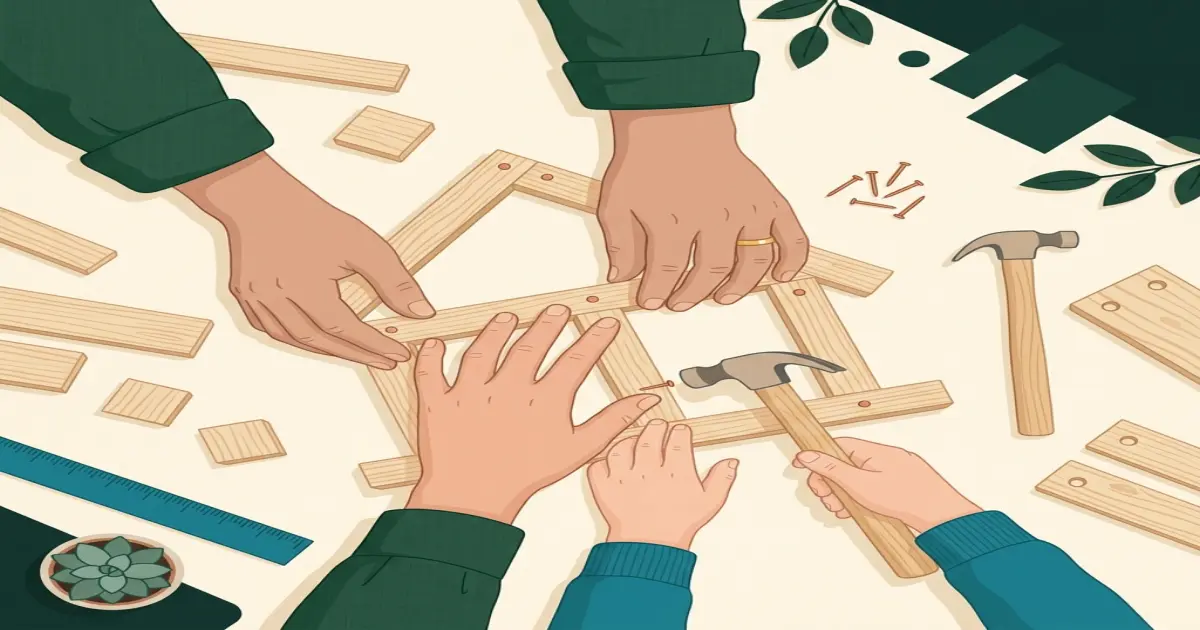
There's a moment in every small build where the thing argues back.
The shelf wobbles. The box won't close. The paper bridge sags in the middle. The seedling leans toward the window no matter how you turn the pot. And the child who made it stands there, looking at the problem, because the problem is looking right back at them.
You can't get that moment from a worksheet. A worksheet can tell you whether a child remembers an answer. It can't make the child care that the answer is wrong.
The wobble is the teacher
Think about what a child actually has to do when a shelf leg comes out short. Look again. Compare the legs. Figure out which one is off, and by how much. Decide whether to trim the others or cut a new one. Measure differently this time, because the first way clearly didn't work.
Nobody had to say "check your work." The shelf said it.
This is the quiet advantage of making things: the feedback is honest and impersonal. A red mark from a teacher can feel like judgment. A wobble is just information. Children will argue with a person about whether something is wrong; they rarely argue with a shelf.
Your whole job in that moment is to not ruin it. Don't rush in with the fix. Ask what changed, what caused it, what you two should measure before the next try — and then let the child do the measuring.
Six subjects, zero announcements
Here's what a child might touch while helping to build a small planter: estimating length, comparing sides, counting screws, thinking about drainage, talking about soil, writing a label, and explaining afterward why one corner came loose.
That's math, science, and language in one afternoon, and at no point did anyone announce a subject. The work came first. The names can come later, if they're needed at all.
This is why skills learned inside a build tend to hold. Measurement isn't a chapter anymore; it's how the shelf became straight. Writing isn't handwriting practice; it's how you tell someone what you did. A child who has needed a skill doesn't ask why they have to learn it.
Start with something the house actually needs
You don't need a workshop, and you shouldn't start with your dream project. Start with the house's ordinary needs: a loose handle, a recipe, herbs for the kitchen window, a shelf for the growing rock collection, a label for the spice jars nobody can tell apart.
Two rules of thumb. The project should be small enough to actually finish, and real enough that someone would notice if it didn't exist. And the child has to own at least one real part — one cut, one measurement, one decision. If you're doing everything while they watch, it's a demonstration, not a build.
Take one photo before dinner
Project work vanishes. The shelf gets used, the food gets eaten, and a week later all anyone remembers is "we did something."
So before the moment is gone, keep one trace. A photo, a rough sketch, or a sentence like this:
“Leo measured the legs for the garden box. One was too short, so he compared it with the others and adjusted the next cut.”
That's not a grade, and it doesn't need to become one. It's just enough to let you see, a month from now, what was actually being practiced: measuring, comparing, correcting, staying with it.
One warning
Adults have a talent for grabbing a living interest and squeezing it into a lesson until it dies.
If your child is happily building, stay light. Ask fewer questions than you want to. Save one thing, not everything. Let the making stay theirs.
The point was never a straight shelf. It's a child who has worked with real materials, made real decisions, been corrected by reality instead of by an adult — and come back to build again.
Written by the Champ23 Team
Champ23 helps parents teaching at home give children challenges worth doing, with enough structure to see the learning and keep going.